What's Inside This Quick Guide
I still remember the first time someone asked me to tell a monocot from a dicot on the spot. I was knee-deep in a wetland, holding a grass-like plant with parallel veins, and I confidently said "monocot." Then my colleague pointed at the flower—six parts, two whorls of three. I was right, but for the wrong reason. That moment stuck with me. The monocot vs dicot split isn't about one single feature. It's a cluster of traits that usually show up together. Miss one and you can still get it right. Miss two or three and you start looking silly.
This isn't a botany textbook. It's what 10 years of field ID has taught me—the shortcuts, the exceptions, and the traps that catch beginners. Let me walk you through the practical side.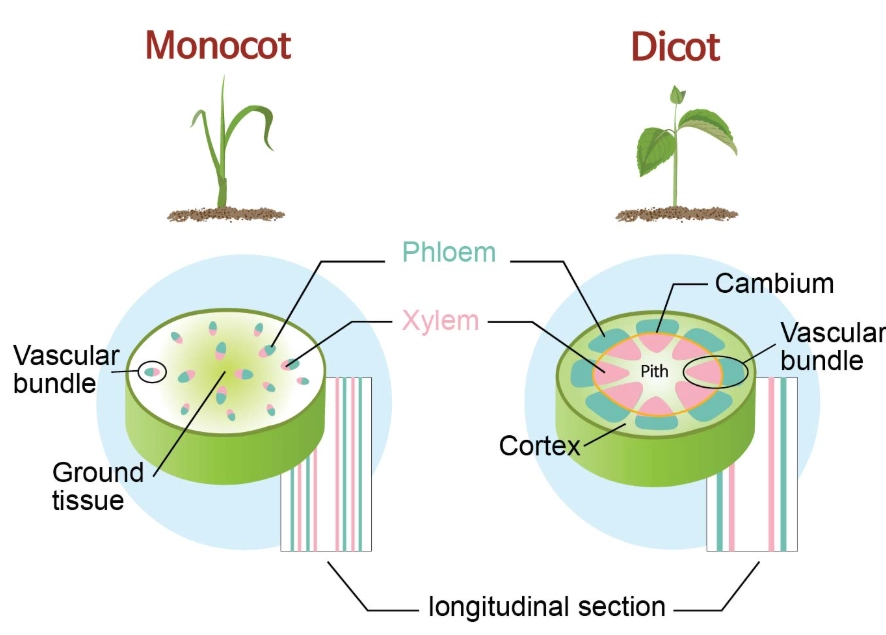
Leaf Veins: The Fastest Test (But Not the Only One)
Hold a leaf up to the light. That's the first thing I do, and honestly, it works 80% of the time.
Monocots have parallel venation. Veins run side by side from base to tip. Think corn, grass, lilies, orchids. Feel the leaf—it's often stiff, with veins you can trace like railroad tracks.
Dicots have netted (reticulate) venation. Veins branch and re-branch like a river delta. Maple, oak, tomato, sunflower—classic examples.
What I've learned the hard way: Some monocots (like yams) have broad leaves with net-like veins. And a few dicots (like plantain) have parallel-looking veins. Don't bet your answer on leaf veins alone. Pair it with flower parts or seed leaves.
A trick I use with students: if the leaf tears easily along a straight line between veins, that's a strong monocot hint. Dicot leaves tend to tear in jagged, irregular paths because the veins are interwoven.
Seed Leaves and Cotyledons: The Original Split
This is where the names come from. Mono-cot = one cotyledon. Di-cot = two cotyledons. When a seed sprouts, count the first leaves.
- Monocots: One seed leaf. It often stays underground or emerges as a single blade. Think of a corn kernel—one shoot, one leaf.
- Dicots: Two seed leaves. They usually emerge above ground and look like tiny paired leaves. Beans are the easiest to observe—split a soaked bean and see the two halves.
But here's the catch: not all seeds germinate the same way. Some dicots (like peas) keep their cotyledons underground. You won't see them unless you dig. So if you're ID-ing a sprout in a garden bed, check if you can find the seed coat or the remains of the cotyledons attached to the stem.
I carry a small hand lens for this. The attachment point—one or two cotyledon scars—is the clincher when flowers aren't available.
Roots and Stems: Less Obvious but Reliable
You can't always dig up a plant, but when you can, the root system tells a clean story.
Monocots have fibrous roots. A dense mat of thin roots, no clear main taproot. Grass, palms, onions—all fibrous.
Dicots typically have a taproot. One main vertical root, often with smaller lateral roots. Carrots, dandelions, oaks—taproot all the way.
Stems don't lie either. Monocot stems have scattered vascular bundles—slice a corn stalk crosswise and you'll see dots scattered like a polka-dot pattern. Dicot stems have vascular bundles arranged in a ring. Look at a sunflower stem cross-section—the bundles form a neat circle.
Quick check: If you can't cut the stem, feel it. Monocot stems are often round and hollow (like bamboo). Dicot stems are more often solid and slightly angular. Not a rule, but a hint.
Flower Parts: Count in Threes or Fours/Fives
This is the most reliable single feature when flowers are present. Count the petals, sepals, or stamens.
| Feature | Monocots | Dicots |
|---|---|---|
| Petal/tepal count | In threes (3, 6, 9) | In fours or fives (4, 5, 8, 10) |
| Pollen aperture | Single pore (monosulcate) | Three pores (tricolpate) |
| Example | Lily (6 tepals), tulip (6) | Rose (5 petals), tomato (5) |
Pollen is microscopic, so save that for lab work. But the petal count is something you can do in the field. I squat down, pluck one flower, and count. Lilies and orchids—always threes. Daisies and roses—fours or fives.
One weird exception: some dicots (like magnolias) have flower parts in threes. It's rare, but it happens. If the petal count says three but the leaf veins are netted, trust the veins. Flowers can be deceptive; vegetative anatomy rarely lies.
Common Mistakes I See All the Time
Beginners fall into the same traps. I did too. Here are the ones that trip people up most.
- Relying on leaf veins alone. I mentioned yams earlier. Broad-leaf monocots exist. Learn to cross-check.
- Assuming all grasses are monocots. True, but sedges and rushes are also monocots—they just look different. The "sedges have edges" rhyme helps: sedge stems are triangular, not round.
- Counting petals wrong. In some flowers, sepals look like petals. Look at the base of the flower—are there two whorls? If yes, you might be counting sepals. Monocots often have tepals (petals and sepals that look identical), so counting is easier.
- Forgetting about gymnosperms. Conifers aren't monocots or dicots—they're gymnosperms. If it has needles or cones, the monocot/dicot split doesn't apply.
I once watched a student confidently label a hosta as a dicot because the leaves were broad. Hostas are monocots. The parallel veins were faint but there. We had to dig up a bit of root to prove it—fibrous, no taproot. That's the moment it clicked for her.
A Real Field Case Study: Two Plants, One Mistake
Last summer I was leading a plant walk in a mixed woodland. We found two plants growing side by side: a wild garlic (Allium ursinum) and a young jack-in-the-pulpit (Arisaema triphyllum). Both had broad, soft leaves. A participant guessed both were dicots.
Wrong. Wild garlic is a monocot—parallel veins, fibrous root, flower parts in threes. Jack-in-the-pulpit is also a monocot (family Araceae). The participant was fooled by leaf shape.
We dug a small root sample (with permission). Wild garlic had a bulb—layered, like an onion. Jack-in-the-pulpit had a corm—solid, starchy. Neither had a taproot. That was the teaching moment: texture and underground structure beat leaf shape every time.
Here's a comparison you can use in the field:
| Field Sign | Wild Garlic (Monocot) | Jack-in-the-Pulpit (Monocot) |
|---|---|---|
| Leaf venation | Parallel, faint | Netted, but irregular |
| Underground part | Bulb (layered) | Corm (solid) |
| Flower parts | 6 tepals | No petals; spathe and spadix |
| Root type | Fibrous | Fibrous |
That table alone won't settle every ID, but it shows why you need multiple features. Monocots are diverse. Some look like dicots until you dig.
FAQ: Monocot vs Dicot Questions I Actually Get Asked
Is there a monocot that looks exactly like a dicot?
Yams (Dioscorea) are the classic troublemaker. Broad leaves, netted veins, climbing habit—they look like dicots. But the flowers are tiny and in threes, and the roots are fibrous. I've seen experienced botanists pause on yams. Check the stem cross-section if you can—scattered bundles, not a ring.
Can I identify monocots and dicots from a photo alone?
Sometimes, but not reliably. Photos miss root structure, stem cross-sections, and often the true petal count if the flower is small. I never confirm an ID from a single photo unless the plant is a textbook example. Get a second angle—flip a leaf, show the base, cut a stem.
Why do some sources say grasses are dicots?
They don't, actually. Grasses are monocots—always have been. If you see a source claiming otherwise, it's either a misprint or a very confused author. The grass family (Poaceae) is the largest monocot family. The confusion might come from the fact that grass flowers are wind-pollinated and don't have showy petals, so beginners can't count flower parts.
What's the fastest field test for monocot vs dicot?
For me, it's leaf tear. Grab a fresh leaf and try to rip it cleanly across the width. Monocot leaves often tear in a straight line between parallel veins. Dicot leaves tear in a jagged, messy line because the veins are a net. It's not 100%, but it's fast and needs no tools. Pair it with a flower count if you want certainty.
I've been doing this long enough to know that the monocot vs dicot question isn't about memorizing a list. It's about pattern recognition. The more you test yourself—even when you're wrong—the sharper the pattern becomes. Next time you're outside, pick a plant. Count the petals. Trace a vein. Dig a root. That's the only way it sticks.
This article was fact-checked against standard botanical references and field observations.


Comment desk
Leave a comment